
| May 3, 2026 | No.205 |
April 2026
(Back Issues Here)
We had 7.77 inches of rain at the Palmira Arriba Station during the month of April 2026.
Rainfall for April 2026 |
|||
Area |
Contributors |
April 2026 |
Total 2026 |
| El Salto Arriba | Beth Corwin | 2.65 | 3.78 |
| Los Cabazos | Don Hughes | 4.82 | 7.37 |
Jaramillo Arriba |
Steve Sarner |
n/a | n/a |
| Jaramillo Arriba | Mark Heyer | n/a | n/a |
| Jaramillo Alto | Steve White | 3.20 | n/a |
| Jaramillo Central | Colleen Anderson | 3.13 | n/a |
Jaramillo Abajo |
John McGann |
9.61 | 14.42 |
| Palo Alto | Nancy Pettersen | 6.59 | 37.42 |
| Valle Escondido | Gisela Remsen | 3.47 | 5.14 |
| Brisas Boquetenas | Dennis Decorte | 9.27 | 17.01 |
| Brisas Boquetenas | Richard Sturz | 11.85 | 21.99 |
Cerro Verde (Volcancito) |
Charlotte Lintz |
3.00 | n/a |
| Canyon Village | Denise McGhee | 3.92 | n/a |
| Caldera | Chris McCall | 4.79 | 7.05 |
| Lucero | Mike Joy | 6.03 | 7.47 |
| Palmira Abajo | Dave Nichols | 5.38 | 10.29 |
Palmira Arriba |
Lloyd Cripe |
7.77 | 9.72 |
| N/A = Not
Available Red = Highest rainfalls Green = Lowest rainfall |
|||
Checking the past data from the Palmira Arriba Station over a span of 20 years, the average rainfall for the months of April is 6.95 inches. The range is a low of 0.28 inches to a high of 18.83 inches. This month's 7.77 inches at the Palmira Arriba Station is +0.16 standard deviations above the mean. So it is less than a standard deviation above normal. Given the small numbers, this is essentially within the average rain for the month of April. We are gradually moving out of the Dry Season into the Rainy Season.
Palmira Arriba Station Average April Rainfalls over 20 Years
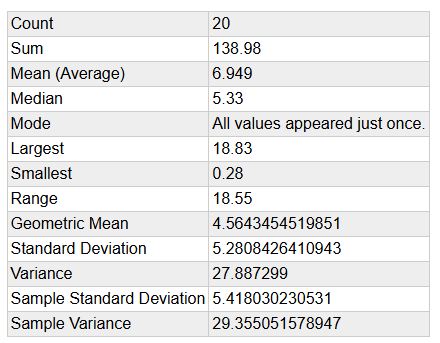
At the Palmira Arriba Station we had 10 days with measureable light precipitation and 20 days without any precipitation. Most of the rain occurred during the last half of April. Our total rain for the year 2026 is now 9.72 inches.
The average winds in April 2026 at the Palmira Arriba station was 3.02 mph and generally from the NNE. Our maximum wind gust was 24.6 mph. Average temperature was 68.34 degrees F. The Highest temperature was 86.0 degrees F. The lowest temperature was 59.0 degrees F. You can check all the previous data for the months of April at this climate link. Changes are gradually occurring. The wind speed was a little lower and temperatures a little lower in April than they were in March.
In the Rainfall Table above note the variations in April rainfall in the different areas of the District of Boquete. The Southern parts of the District received generally had more rainfall than the Northern parts. This commonly occurs as we move into the Rainy Season.
The latest ENSO Cycle Report is saying that "ENSO-neutral conditions are present. Equatorial sea surface temperatures (SSTs) are near-to-above-average in the central and eastern Pacific Ocean. ENSO-neutral conditions favored through April-June 2026 (80% chance). In May-July 2026, El Niño is likely to emerge (61% chance) and persist through at least the end of 2026."
"El Niño is developing faster and stronger than initially projected, with subsurface anomalies now suggesting this event is on a direct trajectory toward Super El Niño status by the second half of the year." Read about it in this informative article from Severe Weather Europe. There is a lot of information in this article about the ENSO cycle. Worth reading carefully.
The IRI (International Research Institute for Climate and Society) (select South America from the Region menu) is predicting a 40% probability of below normal precipitation in Panama during the months of May-June-July 2026 )Yellow areas).
.jpg)
IMHPA (Instituto de Meteorología e Hidrología de Panamá) documents section predicts that during May "...A decrease in accumulated rainfall is expected for this month. Rainfall is forecast to be near or below normal across much of the country, while above-normal rainfall is expected in some areas of Bocas del Toro province, northern Ngäbe Buglé, and northern Veraguas. You can read their entire report and check out the details in the "documents" section at this link.
A big event in April was the successful NASA Artemus II mission from April 1-11 to the back of the moon and deeper into outer space than any previous manned mission. We watched the liftoff, mission reports and the splashdown. It had been 50 years since we watched the last manned mission to the moon. I think one of the most amazing parts of the moon missions has been the photos that humans took of the moon and the earth. The picture of the Earthset from the moon was a powerful perspective of our planet from Apollo 8 in 1968. The newest photo of Earthset taken last month on the Artemis II mission is an improved image with the latest photography equipment. Read about the comparisons here.
Perhaps one of the most important aspects of the recent moon mission is the photography.We are gradually transitioning out of the Dry Season into the Rainy Season. We will gradually change into a lot more rain. May is often one of our rainiest months. The predictions suggest normal to below normal rain. So far we are getting some light rain on nearly a daily basis.
Only time will tell, but I don't think it will be long until we start hearing complaints of too much rain. We humans are hard to please. Regardless, try to adapt under a good roof and keep the umbrellas locked and ready.
Lloyd Cripe