
| September 3, 2025 | No.197 |
August 2025
(Back Issues Here)
We had 12.61 inches of rain at the Palmira Arriba Station during the month of August 2025.
Rainfall for August 2025 |
|||
Area |
Contributors |
August 2025 |
Total 2025 |
| El Salto Arriba | Beth Corwin | 9.17 | 58.39 |
| Bajo Lino | Rodrigo Marciacq | 7.08 | n/a |
| Los Cabazos | Don Hughes | 8.14 | 54.14 |
Jaramillo Arriba |
Steve Sarner |
11.25 | 92.06 |
| Jaramillo Arriba | Mark Heyer | 8.5 | n/a |
| Jaramilla Alto | Steve White | 11.64 | 95.25 |
| Jaramillo Central | Colleen Anderson | 7.49 | 50.60 |
Jaramillo Abajo |
John McGann |
11.77 | 91.59 |
| Palo Alto | Nancy Pettersen | 9.12 | 72.20 |
| Valle Escondido | Gisela Remsen | 11.25 | 54.31 |
| Brisas Boquetenas | Dennis Decorte | 37.53 | n/a |
| Brisas Boquetenas | Richard Sturz | n/a | n/a |
| El Encanto (Volcancito) | Brian Baldwin | 9.88 | 64.84 |
Cerro Verde (Volcancito) |
Charlotte Lintz |
7.52 | 51.73 |
Santa Lucia |
Paula Litt |
12.07 | 85.98 |
| Caldera | Chris McCall | 17.26 | 112.12 |
| Lucero | Mike Joy | 19.21 | 130.12 |
| Palmira Abajo | Dave Nichols | 16.71 | 97.75 |
Palmira Arriba |
Lloyd Cripe |
12.61 | 81.02 |
| N/A = Not
Available Red = Highest rainfalls Green = Lowest rainfall |
|||
We had 12.61 inches of rain at the Palmira Arriba Station in August 2025.. Checking the past data from the Palmira Arriba Station over a span of 19 years, the average rainfall for the months of August is 16.24 inches. The range is a low of 4.24 inches to a high of 39.88 inches. This month's 12.61 inches is -0.39 standard deviations below the mean compared to the means for August. So we had less rain in August than we can normally expect but still within a normal statistical range.
Palmira Arriba Station Average August Rainfalls over 19 Years
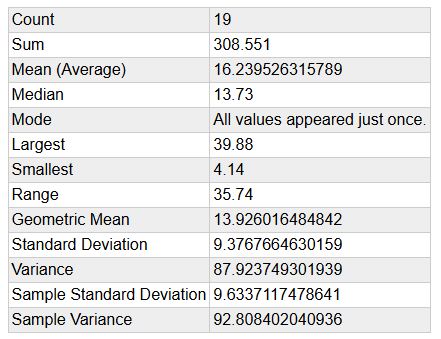
At the Palmira Arriba Station we had 21 days with measureable precipitation and 10 days without.
The table above with the rainfall in various parts of the district of Boquete for August shows levels from 7 to 37+ inches. So far Dennis Decorte has reported the highest rainfall with 37.53 inches at Brisas. Rodrigo Marciacq in Bajo Lino, Colleen Anderson in Jaramillo Central and Charlotte Lintz at Cerro Verde all reported lows of 7+ inches. This is a lot of difference.
The average winds at the Palmira Arriba station were 2.6 mph and generally from the NE. Our maximum wind gust was 23.7 mph. Winds were generally a little lower than in the previous month of July. Average temperature was 68.79 degrees F. The Highest temperature was 83.5 degrees F. Lowest temperature was 59 degrees F. You can check all of our (Palmira Station) previous data for the months of August over the years at this link.
The latest ENSO Cycle Report is saying that "ENSO-neutral is present. Equatorial sea surface temperatures (SSTs) are near-to-below average across most of the Pacific Ocean. ENSO-neutral is most likely through the late Northern Hemisphere summer 2025 (56% chance in August-October). Thereafter, a brief period of La Niña conditions is favored in the fall and early winter 2025-26 before reverting to ENSO-neutral."
Here is a link to a source to better understand El Niño in case you need some help interpreting what this all means. Give this a read and you will learn a lot about this important weather phenomenon that affects global weather. It has more effect upon the Northern Latitudes than it has upon us here in the tropics.
The IRI (International Research Institute for Climate and Society) (select South America from the Region menu) is predicting a dry season with a 45% probability of Above Normal rain for parts of Panama during the months of September - October - November of 2025 (Light Green).
.jpg)
IMHPA (Instituto de Meteorología e Hidrología de Panamá) documents section predicts that during September "...Rainfall values are expected to be above normal in Chiriquí, the Ngäbe Buglé region, central Veraguas, and Herrera. For the rest of the country, monthly rainfall is expected." You can read their entire report and check out the details in the "documents" section at this link.
Chris McCall recently asked me, "Why can there be a lot of variance in the amount of rainfall from different weather stations especially when they are in close proximity?" This is a very good question.
Even assuming that the stations are the same and well calibrated, the answer is a bit complicated. Meteorological studies have shown that if you divide off a section of land and place equal spaced well calibrated weather stations throughout this area, the amount of rainfall collected varies significantly. The simple answer is that rain doesn't fall evenly from even the same clouds passing over. Wind currents along with prevailing winds and terrain along with other factors causes uneven rainfall. There isn't a "shower head" in the sky that casts the droplets evenly like in your shower. I asked the Google Search AI this question:
Why does rain fall unevenly over a local region?
(click on the question to read the AI response)
So you see it is a complicated matter even if all the stations are of equal quality and well calibrated!
We typically have more rain during September and October of the Rainy Season than any of the other months. So be prepared for more rain. Of course we don't know what this year will bring until it happens. September and October are good months to visit other parts of the world if you suffer from rain blues.
However, whether you chose to travel or stay at home in Paradise during these rainy months, be sure and take an umbrella with you just in case.
Lloyd Cripe